

Electric Vehicle Range Extender Market Share Register with CAGR of 13.0% by Trends, Technology Till the Forecast 2035
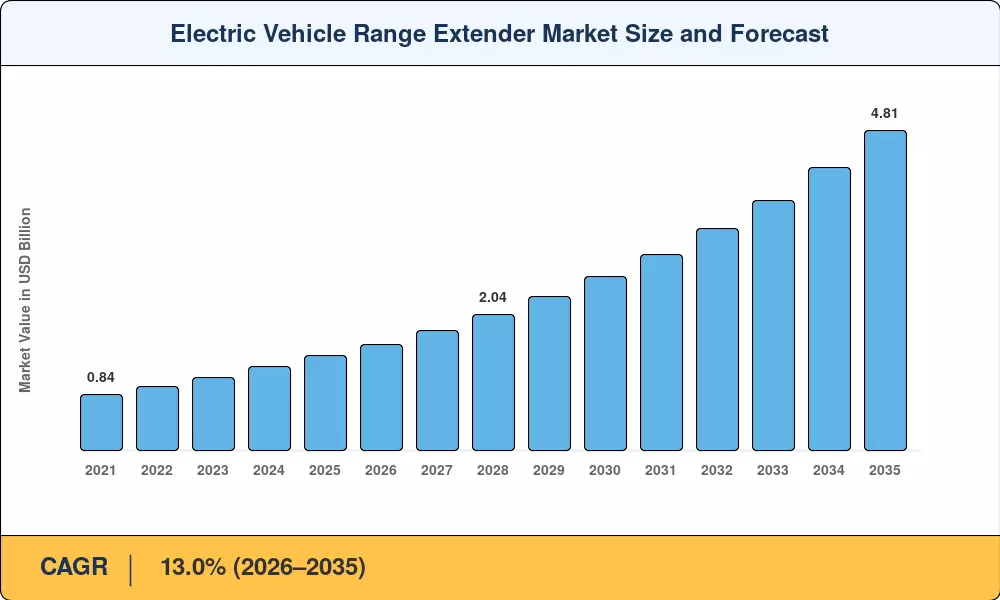
Electric Vehicle Range Extender Market Summary
Europe generated 36.3% of the electric vehicle range extender market revenue in 2025, led by Germany, France, and the Nordic countries.
ICE-based range extenders captured 71.2% of the electric vehicle range extender market in 2025, reflecting mature engine supply chains and lower per-unit costs.”
NY, CA, UNITED STATES, July 15, 2026 /EINPresswire.com/ -- Electric vehicle range extenders are auxiliary power units integrated into electric vehicles to generate additional electricity when the primary battery pack is depleted. These systems typically consist of a small internal combustion engine, generator, and power electronics, or increasingly, fuel cells that convert hydrogen into electricity. Range extenders enable EVs to travel beyond their battery-only range, addressing range anxiety and providing flexibility for long-distance travel, heavy-duty applications, and regions with limited charging infrastructure.— Arti Dhapte
Electric Vehicle Range Extender Market Overview
The electric vehicle range extender market share reached USD 1.43 billion in 2025 and is projected to grow from USD 1.60 billion in 2026 to USD 4.81 billion by 2035, registering a 13.0% CAGR during the forecast period. This expansion is anchored in two converging forces: tightening fleet CO₂ limits across the EU and China's aggressive subsidies for extended-range electric vehicles (EREVs). With more than 40 countries committing to zero-emission vehicle sales mandates by 2035, OEMs are turning to onboard auxiliary power units as a cost-effective bridge between legacy combustion drivetrains and pure battery-electric platforms.
Industry trends indicate a significant technology shift in how range extenders are integrated into EV platforms. Battery pack costs declined to roughly USD 139 per kWh in 2024, tracking toward USD 113 per kWh in 2025, which reshapes the economics of hybrid architectures. Pairing a smaller, lighter battery with a compact range-extending generator allows automakers to cut vehicle curb weight by 15–20% compared with a full-size BEV battery, trimming both material costs and energy consumption per kilometer. This engineering trade-off has reignited interest from European premium brands and Chinese mass-market OEMs alike.
Technological developments are reshaping the market landscape. Compact three-cylinder and rotary engines from suppliers like Mahle and AVL deliver 30–60 kW of continuous electric generation while meeting Euro 7 emission standards. Power converters represent the fastest-growing component category, driven by the transition from silicon-based IGBTs to silicon carbide (SiC) and gallium nitride (GaN) semiconductors that improve conversion efficiency by 3–5 percentage points. Hydrogen fuel cell range extenders are attracting disproportionate R&D investment, with Hyundai, Toyota, and Ceres Power collectively allocating over USD 3 billion to fuel cell development through 2025.
Get Free Sample Report for Detailed Market Insights:
https://www.marketresearchfuture.com/sample_request/22890
Electric Vehicle Range Extender Market Segmentation
By Technology Type
ICE Range Extenders: Captured 71.2% of the market in 2025, reflecting mature engine supply chains and lower per-unit costs
Fuel Cell Range Extenders: Forecast to expand at a 23.8% CAGR through 2035, driven by hydrogen corridor buildouts in Europe and South Korea
Solid-Oxide Fuel Cell Range Extenders: Valued at USD 0.06 billion for high-efficiency stationary and marine crossover applications
By Component
Battery Pack: Accounted for 46.1% of component-level value, underscoring the battery's dual role as primary energy store and buffer for regenerative braking energy
Electric Motor: Valued at USD 0.22 billion for traction and generation dual-use designs
Generator: Growing at 11.5% CAGR with compact rotary and micro-turbine innovations
Power Converters: Fastest-growing component at 19.9% CAGR, driven by SiC/GaN semiconductor adoption
By Vehicle Class
Passenger Cars: Held 66.2% share, driven by consumer range anxiety and OEM platform strategies
Light Commercial Vehicles: Valued at USD 0.18 billion for last-mile delivery fleet electrification
Heavy Commercial Vehicles: Fastest-growing at 22.1% CAGR through 2035 for mining, defense, and construction applications
By Power Output
Less Than 30 kW: 22.3% share for city cars and micro-mobility platforms
30–60 kW: Dominant 43.7% share for passenger car sweet spot
60–100 kW: Valued at USD 0.19 billion for SUVs and light trucks
Above 100 kW: Fastest-growing at 27.0% CAGR for heavy commercial and defense vehicles
Competitive Landscape / Key Players
The electric vehicle range extender market exhibits medium concentration, with the top five players holding an estimated 38-45% combined revenue share. Innovation in compact generators, fuel cell stacks, and power electronics differentiates leaders from followers.
AVL List GmbH (~8-12% revenue share): Offers compact ICE range extender platforms with engineering services leadership and OEM co-development model.
Mahle GmbH (~7-10%): Provides integrated range extender powertrain modules leveraging thermal management and engine expertise.
Rheinmetall AG (~5-8%): Specializes in APU systems for defense and commercial vehicles with dual-use defense-commercial positioning.
Magna International (~6-9%): Delivers complete powertrain integration solutions as a full-vehicle system integrator.
Ballard Power Systems (~5-8%): Focuses on PEM fuel cell range extender modules for heavy-duty commercial vehicles.
Other notable players include Ceres Power Holdings, FEV Group, REFIRE Technology, Plug Power Inc., and Proton Motor Fuel Cell GmbH. Recent developments include Li Auto launching the L6 EREV with a 1.5T range extender delivering 40 kW continuous output and 1,390 km combined range, Mahle unveiling an 85 kW rated continuous output engine-generator system at IAA Mobility, and Ceres Power signing a licensing agreement with Weichai Power to produce solid-oxide fuel cell range extender modules.
Latest Industry News & Developments
Li Auto (April 2024): Launched the L6 EREV with an upgraded 1.5T range extender delivering 40 kW continuous output and a combined range of 1,390 km, setting a new benchmark in the China passenger car segment.
Mahle GmbH (September 2025): Unveiled its advanced production-ready high-voltage range extender system at IAA Mobility, featuring an 85 kW rated continuous output engine-generator combination engineered to offer flexible thermal integration and cost-effective battery sizing for future passenger car platforms.
European Commission (May 2024): Finalized Euro 7 emission standards permitting range extender operation under defined conditions, providing regulatory clarity for OEM product planning.
You can buy this market report at:
https://www.marketresearchfuture.com/checkout?currency=one_user-USD&report_id=22890
Electric Vehicle Range Extender Market Regional Analysis
Europe
Europe generated 36.3% of market revenue in 2025, led by Germany, France, and the Nordic countries. Germany anchors the European market through its OEM engineering base and Tier 1 supplier ecosystem, with BMW's i3 REX legacy platform establishing consumer familiarity and next-generation range extenders targeting sub-30 kg weight with 30 kW continuous output. The UK's 2030 ICE ban with EREV exemptions under review supports a 14.2% CAGR. France's Renault-Nissan range extender platform and Spain's urban clean-air zone expansion contribute to regional growth.
Asia-Pacific
Asia-Pacific is forecast to register a 20.4% CAGR, with China alone accounting for over half of regional unit shipments. China dominates with 58% of regional share, where EREV registrations surpassed 1.2 million units cumulatively through 2024. Government policy treats EREVs favorably under the dual-credit system, and domestic suppliers are scaling hydrogen fuel cell range extender production for commercial trucks. India's FAME III program positions range extenders for intercity trucking where charging infrastructure remains minimal, supporting a 22.5% CAGR. South Korea's Hyundai-Kia fuel cell strategy and Japan's solid-oxide fuel cell R&D further contribute.
North America
North America holds the second-largest share at 24.8%, as U.S. fleet operators evaluate range extenders for medium-duty logistics. The U.S. Department of Energy allocated USD 7.5 billion to charging infrastructure under the NEVI program, yet rural deployment timelines extend past 2030, sustaining demand for range-extending solutions in fleet and commercial segments. Canada's federal ZEV mandate and Mexico's nearshoring of EV component manufacturing support regional growth.
Rest of the World
South America holds USD 0.08 billion, with Brazil's established ethanol infrastructure creating a unique opportunity for flex-fuel range extenders compatible with E100 blends. The Middle East & Africa region is growing at 5.3% CAGR, with Saudi Arabia's Vision 2030 industrial diversification and South Africa's mining fleet decarbonization driving adoption.
Market Challenges & Opportunities
Key Restraints
BEV range improvements through cell-level energy densities exceeding 300 Wh/kg allow production of BEVs with 600-800 km range, reducing the practical need for a separate range-extending powerplant. Solid-state batteries entering limited commercial production by 2028 could further narrow the addressable window. Regulatory classification uncertainty around EREVs as zero-emission or low-emission vehicles complicates long-term product planning in Europe and North America. Added mechanical complexity and weight from range extender systems, along with consumer preference shifts toward pure BEVs and hydrogen fueling infrastructure limitations, further constrain growth.
Emerging Opportunities
Hydrogen fuel cell range extenders for heavy-duty fleets in mining, military logistics, and port handling equipment provide zero-emission operation with fast refueling. Modular multi-fuel generator platforms compatible with gasoline, ethanol, compressed natural gas, and hydrogen reduce per-variant engineering costs by an estimated 30-40%. Emerging-market electrification in Southeast Asia, Sub-Saharan Africa, and South America opens a USD 400-600 million addressable opportunity by 2032. Vehicle-to-Grid and energy arbitrage services enable household savings of EUR 800-1,200 per year. Data-driven predictive maintenance as a service through connected range extender systems yields recurring revenue of 8-12% of hardware selling value over product lifespan.
Future Potential
Solid-state battery integration by 2028-2030 will reshape range extender sizing requirements, potentially shrinking duty cycles to intermittent peak-shaving and favoring ultra-compact turbine architectures. Hydrogen economy convergence as green hydrogen costs decline toward USD 1/kg target makes fuel cell range extenders economically competitive with ICE alternatives. Autonomous vehicle applications for delivery pods, robo-taxis, and mining vehicles require 20+ hour duty cycles critical for autonomous fleet economics. ESG reporting and Scope 3 emissions compliance sustain commercial demand through documented 40-60% lower well-to-wheel CO₂ versus diesel equivalents.
To explore more market insights, visit us at:
https://www.marketresearchfuture.com/reports/electric-vehicle-range-extender-market-22890
The global Electric Vehicle Range Extender Market is positioned for sustained growth, with projections indicating expansion from USD 1.60 billion in 2026 to USD 4.81 billion by 2035, registering a 13.0% CAGR. Market dynamics are driven by the convergence of government zero-emission mandates, battery cost reduction trajectories, and persistent charging infrastructure gaps. The shift from ICE-based range extenders to hydrogen fuel cell variants and modular multi-fuel platforms is transforming the market landscape.
Europe leads with 36.3% revenue share, supported by Euro 7 compliance and premium OEM programs, while Asia-Pacific delivers the fastest regional growth at 20.4% CAGR driven by China's EREV SUV boom and domestic supplier scaling. North America follows with 24.8% share, supported by fleet electrification mandates and medium-duty logistics applications. While challenges including BEV range improvements and regulatory classification uncertainty persist, the long-term industry outlook remains robust, supported by the essential role of range extenders in enabling cost-effective electrification for passenger cars, heavy commercial vehicles, and emerging-market applications. The decade ahead will reward suppliers who can deliver modular, multi-fuel generator platforms adaptable to hydrogen and synthetic fuels, positioning the electric vehicle range extender market as a critical bridge technology in the global energy transition.
More Related Reports from MRFR Library:
Air Circuit Breaker Market https://www.marketresearchfuture.com/reports/air-circuit-breaker-market-33606
Air Core Drilling Market https://www.marketresearchfuture.com/reports/air-core-drilling-market-33613
Closed Core Power Transformer Market https://www.marketresearchfuture.com/reports/closed-core-power-transformer-market-33622
Closed Core Transformer Market https://www.marketresearchfuture.com/reports/closed-core-transformer-market-33629
Air Insulated Medium Voltage Switchgear Market https://www.marketresearchfuture.com/reports/air-insulated-medium-voltage-switchgear-market-33632
Air Insulated Ring Main Unit Market https://www.marketresearchfuture.com/reports/air-insulated-ring-main-unit-market-33636
Closed Loop Current Transducer Market https://www.marketresearchfuture.com/reports/closed-loop-current-transducer-market-33640
Air Cooled Synchronous Condenser Market https://www.marketresearchfuture.com/reports/air-cooled-synchronous-condenser-market-33645
Agrivoltaics Market https://www.marketresearchfuture.com/reports/agrivoltaics-market-33648
Aluminum Cable Market https://www.marketresearchfuture.com/reports/aluminum-cable-market-33651
Larry Wilson
WantStats Research And Media Pvt. Ltd.
+1 855-661-4441
email us here
Visit us on social media:
LinkedIn
Facebook
YouTube
X
Legal Disclaimer:
EIN Presswire provides this news content "as is" without warranty of any kind. We do not accept any responsibility or liability for the accuracy, content, images, videos, licenses, completeness, legality, or reliability of the information contained in this article. If you have any complaints or copyright issues related to this article, kindly contact the author above.
